
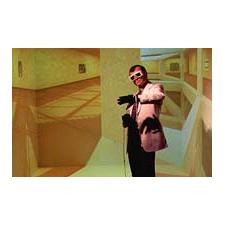
Andries van Dam
Andries van Dam
Thomas J. Watson Jr. University Professor of Technology and Education, Professor of Computer Science
Overview
Andries van Dam is the Thomas J. Watson Jr., University Professor of Technology and Education and Professor of Computer Science. He has been a member of Brown's faculty since 1965, is a founder of Brown's Computer Science Department, and was its first Chairman from 1979 to 1985. From 2002 to 2006 he was Brown's first Vice President for Research. His research includes work on computer graphics, hypermedia systems, post-WIMP user interfaces (including pen-centric computing), and educational software. Over the last four decades he has worked on systems for creating and reading electronic books with interactive illustrations for use in education and research.
He is the co-author of nearly a dozen books, including "Computer Graphics: Principles and Practice", with James D. Foley, Steven K. Feiner, and John F. Hughes (Addison-Wesley 1990). He received a B.S. degree (with Honors) in Engineering Sciences from Swarthmore College in 1960 and a Ph.D. in Electrical Engineering from the University of Pennsylvania in 1966. He is a Fellow of ACM, IEEE, the American Association for the Advancement of Science, and the American Academy of Arts & Sciences, and is a member of National Academy of Engineering. His awards include the ACM Steven A. Coons Award for Outstanding Creative Contributions to Computer Graphics and the IEEE James H. Mulligan, Jr. Education Medal. He holds honorary doctorates from Swarthmore College and Darmstadt Technical University.
Brown Affiliations
Research Areas
Research
Research Overview
Research Statement
His research group's post-WIMP (Windows, Icons, Menus, Pointing-device) user interface research has included both IVR (Immersive Virtual Reality) interaction research on the one hand and gesture-based user interfaces for both desktop computers and the Tablet PC on the other. The IVR research uses the Cave facility (an 8' cube with three walls and floor that are stereo projection surfaces) and includes projects such as scientific visualization of Mars exploration and human artery blood flow. Gesture-based user interface research has included Sketch, a two-handed gestural constraint-based sketching system for the desktop and more recently, work with the Tablet PC that has culminated in the March 20th founding of the Microsoft Center for PenCentric Computing.
His pioneering work in hypertext and text processing, dating back to HES in 1967, helped created the field through hypermedia systems such as HES, FRESS, EDS, and IRIS Intermedia, all of which pre-date, foreshadow, and functionally provide features still unavailable on the Web. In 1990 he was a co-founder and chief scientist of Electronic Book Technologies, the first company to use the then still new SGML (the precursor of XML) to build hypertext-based electronic books, primarily for technical documentation.
The hypertext research stimulated his interests in systems development so that in parallel with the ongoing work on FRESS, EDS, and Intermedia, he and his team conducted research in software systems, compilers, microprogramming, and distributed computing. As part of the efforts in distributed programming in 1976 and 1977 he co-founded the distributed computing workshops at Brown that later evolved to become the IEEE ICDCS conferences, which celebrated their 25th anniversary last year.
Undergirding all the computer graphics, hypermedia, systems, and user interface research has been a lifelong interest in the use of software for education, starting with the use of FRESS to teach courses in environment science and poetry and continuing with Intermedia used for courses in Biology and Literature.
In more recent years he and his team have continued to develop educational software tools that combine interaction within hypermedia information structures, starting with Exploratories, which are Java applets designed to teach concepts in computer graphics either as stand-alone units or embedded within hypermedia frameworks.
Their most recent education research includes GTT (Graphics Teaching Tool), a Java-based interactive application; Tablet PC-based projects such as MathPad, a mathematical sketching application for mathematical problem solving, and ChemPad, an organic chemistry 3D molecule visualization tool; and Immune Attack, a educational software biology simulation game being deployed in the Spring of 2006;
Looking towards the next generation of educational software, he is developing a theoretical framework called Clip Models, which are simulation-based families of components that represent multiple levels of explanatory power and simulation fidelity designed to interoperate and to be assembled into systems. Unlike clip art, clip models emphasize behavior, interaction and exploration, and interoperability.
Funded Research
Visual Digital Literacy: Curricular and Modules for the IT Worker (PI), National Science Foundation (subcontract via Maricopa County Community College District), $300,000, 08/01/05-07/31/08
Advanced Visualization in Solar System Exploration and Research (ADVISOR) (Co-PI), NASA, $870,000, 10/01/04-9/30/07
ITR: Collaborative Research - (ASC) - (sim + int): Building Biologically Based Immune System Simulations for Education and Training (PI), National Science Foundation, $160,000, 10/1/04-9/30/06
A Digital Notepad for Education (PI), JADL, $350,000, 7/24/03-3/30/06
Application Driven Research, Development, and Evaluation of Interactive Scientific Visualization Techniques in Multiple Working Environments (PI), Department of Energy (DOE), $900,000, 9/15/03-9/14/06
Developing Immersive VR Techniques for Interactive Scientific Visualization (PI), Lawrence Livermore National Laboratory (LLNL), $525,000, 6/1/03-5/31/06
Gift of Tablet PCs for Electronic Student Notebook Project (PI), Microsoft, $25,000, 2003
Remarkable Texts: A Digital Notepad for the NSDL (PI), National Science Foundation, $425,000, 11/1/02-10/31/04
ITR/SY: Electronic Books for the Tele-Immersion Age: A New Paradigm for Teaching Surgical Procedures (PI), National Science Foundation, $1,750,000, 9/01/01- 8/31/05
A Gesture Driven Music Notepad (PI), Microsoft, $128,387, 9/01/01-10/15/02
Special Projects: Workshop to Establish a Research Agenda in Learning Science and Technology (PI), National Science Foundation, $100,000, 9/15/00-8/31/01
Accessible Color II (PI), Adobe, $100,000, 06/01/00 - 05/31/01
Collaborative Research: A Component Repository and Environment for Assembly of Teaching Environments (CREATE) (PI), National Science Foundation, $244,000, 06/01/00 - 02/02/03
Technologies for Interactive Visualization of Large Data Sets (PI), Lawrence Livermore National Laboratory (LLNL), $1,198,536, 07/27/99 - 06/30/03
Accessible Color (PI), Adobe, $100,000, 03/01/99 - 02/28/00
Research on Computer Graphics (PI), Microsoft, $100,000, 1999-2002
MRI: Acquisition of Equipment for Telecollaboration, Telepresence and Design (PI), National Science Foundation (subcontract via University of Utah), $304,375, 10/01/98 - 09/30/02
Collaborative Research: Java 3D (PI), Sun Microsystems, $50,000, 01/01/98 - 12/31/98
Support for the 1997 Symposium on Interactive 3D Graphics (PI), Office of Naval Research (ONR), $20,000, 04/25/97 - 12/31/97
1997 Symposium on Interactive 3D Graphics (PI), ARL, $20,000, 02/25/97 - 01/31/98
1997 Symposium on Interactive 3D Graphics (PI), National Science Foundation, $25,000, 03/15/97 - 02/2/998
User Interface Technology Transfer to NASA's Virtual Wind Tunnel System (PI), NASA, $40,000, 04/01/97 - 03/31/98
Vannevar Bush Symposium (PI), National Science Foundation, $25,000, 10/01/95 - 09/30/96
Self as a First Programming Language at Brown University (PI), Sun Microsystems, $70,000, 1994-1996
Exploiting Multiprocessors for Time-Critical 3D Graphics (PI), Sun Microsystems, $180,000, 1994-1996
Three Dimensional User Interfaces for Scientific Visualization (PI), NASA, $400,000, 04/01/93 - 03/31/97
Science and Technology Center in Computer Graphics and Scientific Visualization (PI), National Science Foundation, $7,310,698 out of $35,473,614, 02/01/91 - 07/31/02
Collaborative Research on 4D modeling (PI), Sun Microsystems, $200,000, 1991-1993
A Framework for an Object-Oriented Time-Parameterized Modeling and Animation Platform (PI), IBM, $360,000, 1991-1993
Collaborative Research on 4D modeling (PI), Sun Microsystems, $100,000, 1991-1992
Demonstration of Animation (PI), IBM, $25,000, 1990
4D Modeling (PI), IBM, $50,000, 1990-1991
Collaborative Research on 4D Modeling (PI), Sun Microsystems, $100,000, 1990-1991
Computer Graphics Group Affiliate (PI), NCR Corporation, $300,000, 1989-1992
Cooperative Research and Development (PI), NCR Corporation, $75,000, 1989
Interactive User-Controlled Animation (PI), NCR Corporation, $40,000, 1988
Project Quattro (PI), Digital Equipment Corporation, $140,000, 1986 - 1987
Project Quattro (PI), Digital Equipment Corporation, $250,000 plus $750,000 equipment credit, 1985 - 1986
Ideographics (Co-PI), Defense Advanced Research Projects Agency (DARPA)-Office of Naval Research (ONR), $1,700,000, 1983 - 1987
An Instructional Computing Environment (PI), Exxon Education Foundation, $229,143, 1983 - 1986
Research in Interactive Computer Graphics (PI), Atari Computer Division, $150,000, 1982 - 1983
An Integrated Experimental Environment for Research in Computer Science (Co-PI), National Science Foundation, $2,736,377, 1982-1987
Document Production Systems (PI), IBM (Research Agreement), $295,000, 1981 - 1983
Cause: Integrated Personalized Computing Environments (Co-PI), National Science Foundation, $250,000, 1980 - 1983
Automated Technical Documentation and Assistance (PI), Office of Naval Research, $891,084, 1980-1985
Scholarly Work
View My Full Publications List Here
Background
Education and Training
| Year | Degree | Institution |
|---|---|---|
| 1966 | PhD | University of Pennsylvania |
| 1963 | MS | University of Pennsylvania |
| 1960 | BS | Swarthmore College |
Honors and Awards
Affiliations
Affiliations
IEEE, Fellow
AAAS, Fellow
NAE
American Academy of Arts & Sciences
Teaching
Teaching Overview
CS123: This course offers an in-depth exploration of fundamental concepts in 2D and 3D computer graphics. It introduces 2D raster graphics techniques, including scan conversion, simple image processing, interaction techniques and user interface design. The bulk of the course is devoted to 3D modeling, geometric transformations, and 3D viewing and rendering. A sequence of assignments in C++ culminates in a simple geometric modeler and ray tracer. Prerequisite: CS16 or 18; either 32 or 36 is strongly recommended. Students who do not know C++ should take a minicourse on it offered during the first week of the semester. Math 52 is strongly recommendended.
Teaching
| CSCI 0150 - Introduction to Object-Oriented Programming and Computer Science |
| CSCI 1230 - Introduction to Computer Graphics |
| CSCI 1234 - Computer Graphics Lab |
| CSCI 1951V - Hypertext/Hypermedia Seminar: The Web Was Not the Beginning and the Web Is Not the End |
| CSCI 1951V - Hypertext/Hypermedia: The Web Was Not the Beginning and the Web Is Not the End |