
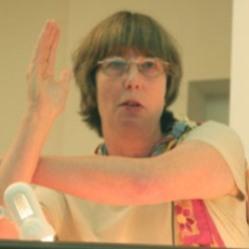
Richards, Joan
Richards, Joan
Professor Emerita of History
Overview
Joan Richards earned a PhD in the History of Science from Harvard in 1981. Her first bookMathematical Visions: Non-Euclidean Geometry in Victorian Englandfocused on the reception of a geometrical theory in the wider culture of nineteenth century England. Her second bookAngles of Reflectionwas at once a memoir and an exploration of the logical work and family life of Augustus De Morgan. She is currently writing a two-generational family history focusing on changing views of rationality in the Frend/De Morgan family. All of these projectsas well as her many mathematical historical articlesare linked by an abiding interest in the ways that mathematics has served as a model of thinking that has developed in interaction with other approaches to the human mind, be they psychological, spiritual, physical, or even phrenological.
Brown Affiliations

Publications
| Richards, Joan. "Eloge: Erwin Hiebert." Isis, vol. 105, no. 1, 2014, pp. 157-160. |
| Richards, Joan L. "Raymond Flood ; Adrian Rice ; Robin Wilson (Editors). Mathematics in Victorian Britain . ix + 466 pp., illus., index. Oxford: Oxford University Press, 2011. £29.99 (cloth)." Isis, vol. 104, no. 4, 2013, pp. 853-855. |
| Richards, Joan. "God, Truth and Mathematics in Nineteenth-century England." Theology and Science, vol. 9, no. 1, 2011, pp. 53-74. |
| Richards, Joan L. "This Compendious Language”: Mathematics in the World of Augustus De Morgan." Isis, vol. 102, no. 3, 2011, pp. 506-510. |
| Richards, Joan L. "In Search of the “Sea-Something”: Reason and Transcendence in the Frend/De Morgan Family." Science in Context, vol. 20, no. 03, 2007, pp. 509. |
| Richards, Joan L. "Historical Mathematics in the French Eighteenth Century." Isis, vol. 97, no. 4, 2006, pp. 700-713. |
Research
Research Overview
Research Statement
Naming the family that included these characters is difficult because its greatest continuity lay in a matrilineal line. Theophilus Lindsey, entered it when he married Hannah Elsworth, who was the step-daughter of his dear friend and mentor, Francis Blackburne. Hannah and Theophilus had no children, but William Frend was their protégé, who forged a family connection when he married Hannah's niece, Sarah Blackburne. Augustus De Morgan entered the family when he married William's and Sarah's eldest daughter, Sophia Frend. The name that would most firmly tie together Hannah and Theophilus Lindsey, William and Sarah Frend, and Augustus and Sophia De Morgan would be neither Lindsey nor Frend nor De Morgan, but rather Blackburne. Focusing on this family is a first step toward restoring some measure of recognition to the women who carried this name, and the set of relationships that united and sustained their men.
The members of this family were intellectually bound by a common commitment to a view of reason rooted in the philosophy of John Locke. Over the decades that separated Lindsey from De Morgan, Lockean reason moved from the reasoned theology of eighteenth-century Unitarians to the reasoned mathematics of the nineteenth. The shift was more a shift in the center of gravity than a radical change; there was much that was mathematical in Lindsey's and Frend's theology, much that was theological in De Morgan's mathematics, and much that was both religious and reasoned in Sophia's spiritualism. That human beings were essentially defined by their reason was a constant that tied all of these people together, but the terms of expression of that position changed considerably.
Among the members of this family, reason acted as an ideal as well as an idea; its implications were as much practical as they were intellectual. Both Lindsey and Frend saw their conclusion that Jesus was a human being to be the necessary outcome of a reasoned reading of the Bible, but their reasoning did not stop at this doctrinal level. Their insight about the humanity of Jesus led them immediately to the recognition that Jesus's life was a human model to be emulated. In this way, a commitment to reason in religion led seamlessly to a commitment to radical action. Many other Anglicansincluding the nominal patriarch of this family, Francis Blackburnesaw clearly that there were problems with the details of church doctrine, but they saw no need to leave the church. Lindsey's understanding of reasoned Unitarianism required him to act.
All of the members of the family were committed to radical dissent. Theophilus Lindsey sacrificed a comfortable position in the Anglican church when he formed a Unitarian one. William Frend was unemployable for 15 years after he was expelled from Cambridge for his religious and political views. Augustus De Morgan took his place among the family's martyrs to conscience when he resigned his position at University College London (UCL) over a disagreement about the place of religion there. All of the women passionately defended their husbands, even as they struggled to adjust to the economic and social fall-outs of these stands.
The same God that held Lindsey accountable for the doctrines of his church held him accountable for bringing out the reason of the people around him. Education was a central duty for all members of the family, male and female, young and old. Theophilus and Hannah Lindsey created a Sunday School dedicated to teaching the poor of their parish; William Frend was similarly involved with teaching the poor in Cambridge; Sarah Frend and Sophia De Morgan taught their children at home; Augustus De Morgan taught other people's children at UCL, and all of them wrote textbooks of one form or another. They were constantly looking for ways to set loose the power of reason by supporting mechanics institutes, volunteering in schools, serving on the boards of struggling colleges.
These traditions were relatively stable, but the circumstances of their expression changed considerably between the mid-eighteenth century, when Lindsey left the Anglican church and the mid-nineteenth century when the Augustus and Sophia De Morgan were in their primes. A family history is the best way to understand the human experience of these massive changes. Like biography, a family history cuts across the boundaries of public and private, but in a way that differently balances individual and tradition. Individuals play an important role, but their individuality is always enmeshed with others and attenuated by the flow of time. A family history offers enough breadth to explore the variety of ways that ideas become ideals that shape the lives of the men and women who hold them.
Funded Research
Scholarly Work
"Parallel Universes: Natural Theology and the Power of Reason" to appear in a special edition of Science in Context devoted to Knowing and Believing.
With Michael Hobart: "Augustus De Morgan's Logic" to appear in British Logic in the Nineteenth Century, vol 4 of The Handbook of the History of Logic, John Wood editor. Scheduled for publication Spring, 2007.
"'In a rational world all radicals would be exterminated:' Mathematics, Logic and Secular Thinking in Augustus De Morgan's England" Science in Context 15 (2002): 137-164.
Angles of Reflection. W. H. Freeman, 2000.
"The Probable and the Possible in Early Victorian England" in Bernard Lightman ed. Contexts of Victorian Science. Chicago University Press, 1997.
"The History of Mathematics and l'espirit Humain: A Critical Reappraisal" in Osiris Vol. 10. Constructing Knowledge in the History of Science second series 10 (1995) 122-138.
"God, Truth, and Mathematics in Victorian England" in Nye, Richards, and Stuewer eds. The Invention of Physical Science. (Dordrecht: Kluwer, 1992) 51-78.
Co-editor with Mary Jo Nye and Rober Stuewer, The Invention of Physical Science: Intersections of Mathematics, Theology and Natural Philosophy since the Seventeenth Century Essays in Honor of Erwin N. Hiebert Kluwer Academic Publishers 1992.
"Rigor and Clarity: Foundations of Mathematics in France and England, 1800- 1840," Science in Context 4 (1991): 297-319.
Mathematical Visions: The Pursuit of Geometry in Victorian England, Academic Press. Fall, 1988.
"Augustus De Morgan, The History of Mathematics and the Foundations of Algebra." Isis. 78 (1987): 6-30.
"Projective Geometry and Mathematical Progress in Victorian Britain" Studies in the History and Philosophy of Science, 17 (1986): 297-325.
"The Art and the Science of British Algebra: A Study in the Perception of Mathematical Truth," Historia Mathematica 7 (1980): 342-65.
"The Reception of a Mathematical Theory: Non-Euclidean Geometry in England, 1868-1883," in Barry Barnes and Steven Shapin eds. Natural Order: Historical Studies of Scientific Culture. Sage Publications, Beverly Hills, 1979.
"Evolution of Empiricism: The non-Euclidean Geometry of Herman von Helmholtz," British Journal for the Philosophy of Science 28 (September, 1977): 235-253.
Background
Education and Training
| Year | Degree | Institution |
|---|---|---|
| 1981 | PhD | Harvard University |
| 1979 | MA | Harvard University |
| 1971 | BA | Harvard-Radcliffe College |
Honors and Awards
Fellow, Max Planck Institut für Wissenschaftsgeschichte Fall 2004
Guggenheim Foundation Fellowship 2002-03
American Council of Learned Societies Research Fellowship 2001-02
National Science Foundation Travel Grant 2001-2002
Fellow, Max Planck Institut für Wissenschaftsgeschichte. Spring, 2001
Fellow, Max Planck Institut für Wissenschaftsgeschichte. Spring, 1997
Fellow, Wissenschaftskolleg, Berlin, Germany 1995-96
Fellow, Dibner Institute, Cambridge, Massachusetts 1994-95
Affiliations
Affiliations
Teaching
Teaching
| HIST 1825M - Science at the Crossroads |
| SCSO 1000 - Introduction to Science and Society: Theories and Controversies |
| STS 1000 - Introduction to Science and Society: Theories and Controversies |