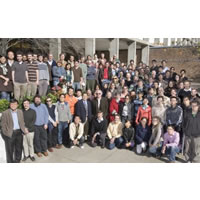
Matt LeBlanc is an Assistant Professor of Physics (Research) at Brown University, where he leads a group working at the convergence of experimental high-energy physics, computational data science and particle physics phenomenology. He completed his Ph.D. in experimental particle physics at the University of Victoria (Canada) and held postdoctoral appointments at the University of Arizona, CERN and the University of Manchester (UK) as a member of the ATLAS Collaboration. He joined the CMS Collaboration on arriving at Brown in 2024, where he is a Level-3 convener in the Monte Carlo Generators group, and is Deputy Experimental Community Representative of the U.S. Muon Collider Collaboration.
Matt uses LHC data to sharpen our understanding of Quantum Chromodynamics — the least precisely understood of the Standard Model's gauge theories — and takes a physics-driven approach to the development of scientific computing algorithms for particle physics. His work leverages AI/ML algorithms and Optimal Transport, a framework borrowed from applied mathematics that supplies a physically meaningful measure of the distance between collider events. He also studies hadronic object reconstruction and the simulation of beam-induced backgrounds for a proposed multi-TeV muon collider.
Students from physics, mathematics & applied mathematics, computer science and engineering have contributed to his group's work.
| Rishabh Jain, Lauren Hay, Matt LeBlanc, Jennifer Roloff. "A Phase-Space Inclusive Figure of Merit Based in Optimal Transport for Validating Monte Carlo Reweightings." Submitted to the proceedings of CHEP 2026 (EPJ Web of Conferences), 2026. |
| J. Scott Berg, David Bizzozero, Tulika Bose, Lance Cooley, John Dervan, Auralee Edelen, Peter Elmer, Cristiano Fanelli, Tova Holmes, Walter Hopkins, Sergo Jindariani, Michael Kagan, Maira Khan, Young-Kee Kim, Matt LeBlanc, Lawrence Lee, Matthias Liepe, Radha Mastandrea, Patrick Meade, Federico Meloni, Chad Mitchell, Linh Nguyen, Isobel Ojalvo, Ryan Roberts, Nicholas Smith, Jean-Luc Vay, Gordon Watts, Drew Winder, Chenran Xu, Katsuya Yonehara. "AI Acceleration of Muon Collider R&D: A Report from the AI4MuC Workshop." arXiv preprint, 2026. |
| CMS Collaboration. "Evidence for the dead-cone effect in bottom quark initiated jets produced in proton-proton collisions at sqrt(s)=13 TeV." Submitted to PRL, 2026. |
| Radha Mastandrea, Shiyu Peng, Benjamin Rosser, Matt LeBlanc. "Fast BIB simulation at a future Muon Collider with generative machine learning." arXiv preprint , 2026. |
| Lauren Hay, Rishabh Jain, Matt LeBlanc, Jennifer Roloff. "Learning the Geometry of Collider Events with Metric-Aware Deep Sets." arXiv preprint, 2026. |
| Regan Doherty, Lauren Hay, Rishabh Jain, Matt LeBlanc, Julia Marrinan, Camille Mauceri, Jennifer Roloff. "MadGraph5_aMC@NLO + Pythia 8.3 event samples for cell resampling studies (13 TeV, Z+jets and top quark pair production)." Zenodo, 2026. |
| CMS Collaboration. "Measurement of four-point energy-energy correlator subspaces in Z+jets events." Preprint, 2026. |
| Regan Doherty, Lauren Hay, Rishabh Jain, Matt LeBlanc, Julia Marrinan, Camille Mauceri, Jennifer Roloff. "Optimal-Transport-Based Cell Resampling for Negative and Pathological Event Weights." Submitted to JHEP, 2026. |
| Lauren Hay, Rishabh Jain, Matt LeBlanc and Jennifer Roloff. "Optimizing Cell-Based Negative Weight Mitigation with Optimal Transport." Submitted to the proceedings of CHEP 2026 (EPJ Web of Conferences), 2026. |
| Stefan Höche, Matt LeBlanc, Jennifer Roloff & Grant Whitman. "Massive tree-level splitting functions beyond kinematical limits." Physical Review D, vol. 113, no. 5, 2025, pp. 054009. |
| ATLAS Collaboration. "Measurement of jet track functions in pp collisions at sqrt(s)=13 TeV with the ATLAS detector." Phys. Lett. B, vol. 868, no. 139680, 2025. |
| Rikab Gambhir, Matt LeBlanc & Yuanchen Zhou. "Pythia8 and Herwig7 Boosted Top and QCD Datasets." Zenodo, 2025. |
| Ferguson, LaFleur et al. "The Future of Artificial Intelligence and the Mathematical and Physical Sciences (AI+MPS)." 2025. |
| Rikab Gambhir, Matt LeBlanc, Yuanchen Zhou. "The Pareto Frontier of Resilient Jet Tagging." 39th Conference on Neural Information Processing Systems (NeurIPS 2025) Workshop: Machine Learning and the Physical Sciences, 2025. |
| Cari Cesarotti and Matt LeBlanc. "A Field Guide to Event-Shape Observables Using Optimal Transport." Accepted by JHEP, 2024. |
| Andersen et al. "Les Houches 2023: Physics at TeV Colliders: Standard Model Working Group Report." Physics of the TeV Scale and Beyond the Standard Model: Intensifying the Quest for New Physics (PhysTeV 2023), 2024. |
| ATLAS Collaboration. "Measurements of jet cross-section ratios in 13 TeV proton--proton collisions with ATLAS." Physical Review D, vol. 110, no. 7, 2024, pp. 072019. |
| ATLAS Collaboration. "Measurements of Lund subjet multiplicities in 13 TeV proton-proton collisions with the ATLAS detector." Phys. Lett. B, vol. 859, 2024, pp. 139090. |
| ATLAS Collaboration. "Constituent-based W-boson tagging with the ATLAS detector." ATL-PHYS-PUB-2023-020, 2023. |
| Florian Dachs et al. "Development of a large-area, light-weight module using the MALTA monolithic pixel detector." Nuclear Instruments and Methods in Physics Research Section A: Accelerators, Spectrometers, Detectors and Associated Equipment, vol. 1047, 2023, pp. 167809. |
| Matt LeBlanc, Benjamin Nachman, Christof Sauer. "Going off topics to demix quark and gluon jets in αS extractions." Journal of High Energy Physics, vol. 2023, no. 2, 2023. |
| Heinz Pernegger et al. "MALTA-Cz: a radiation hard full-size monolithic CMOS sensor with small electrodes on high-resistivity Czochralski substrate." Journal of Instrumentation, vol. 18, no. 09, 2023, pp. P09018. |
| ATLAS Collaboration. "Measurements of multijet event isotropies using optimal transport with the ATLAS detector." Journal of High Energy Physics, vol. 2023, no. 10, 2023. |
| ATLAS Collaboration. "New techniques for jet calibration with the ATLAS detector." European Journal of Physics C, vol. 83, no. 8, 2023, pp. 761. |
| Milou van Rijnbach et al. "Performance of the MALTA telescope." The European Physical Journal C, vol. 83, no. 7, 2023. |
| ATLAS Collaboration. "Pursuit of paired dijet resonances in the Run 2 dataset with ATLAS." Physical Review D, vol. 108, no. 11, 2023. |
| Francesco Piro et al. "A 1 μW Radiation-Hard Front-End in a 0.18-μm CMOS Process for the MALTA2 Monolithic Sensor." IEEE Transactions on Nuclear Science, vol. 69, no. 6, 2022, pp. 1299-1309. |
| Matt LeBlanc, on behalf of the ATLAS & CMS Collaborations. "Jet and photon physics in ATLAS and CMS." Proceedings of the 56th Rencontres de Moriond on QCD and High Energy Interactions, 2022. |
| Ben Nachman, Salvatore Rappoccio, Nhan Tran et al. "Jets and Jet Substructure at Future Colliders." Frontiers in Physics, vol. 10, 2022. |
| Abhishek Sharma et al. "Latest developments and characterisation results of the MALTA sensors in TowerJazz 180nm for High Luminosity LHC." Proceedings of The European Physical Society Conference on High Energy Physics — PoS(EPS-HEP2021), 2022. |
| Dominik Dobrijević et al. "MALTA3: Concepts for a new radiation tolerant sensor in the TowerJazz 180 nm technology." Nuclear Instruments and Methods in Physics Research Section A: Accelerators, Spectrometers, Detectors and Associated Equipment, vol. 1040, 2022, pp. 167226. |
| M. van Rijnbach et al. "Radiation hardness and timing performance in MALTA monolithic pixel sensors in TowerJazz 180 nm." Journal of Instrumentation, vol. 17, no. 04, 2022, pp. C04034. |
| Matt LeBlanc et al. "Recent results with radiation-tolerant TowerJazz 180 nm MALTA sensors." Nuclear Instruments and Methods in Physics Research Section A: Accelerators, Spectrometers, Detectors and Associated Equipment, vol. 1041, 2022, pp. 167390. |
| Giuliano Gustavino et al. "Timing performance of radiation hard MALTA monolithic pixel sensors." Journal of Instrumentation, vol. 18, no. 03, 2022, pp. C03011. |
| ATLAS Collaboration. "Identification of hadronically-decaying top quarks using UFO jets with ATLAS in Run 2." ATL-PHYS-PUB-2021-028, 2021. |
| ATLAS Collaboration. "Optimisation of large-radius jet reconstruction for the ATLAS detector in 13 TeV proton-proton collisions." European Journal of Physics C, vol. 81, no. 4, 2021, pp. 334. |
| ATLAS Collaboration. "Towards a precise interpretation of the top quark mass parameter in ATLAS Monte Carlo samples." ATL-PHYS-PUB-2021-034, 2021. |
| S. Amoroso et al. "Les Houches 2019: Physics at TeV Colliders: Standard Model Working Group Report." 2020. |
| ATLAS Collaboration. "Measurement of soft-drop jet observables in pp collisions with the ATLAS detector at sqrt(s)=13 TeV." Physical Review D, vol. 101, no. 5, 2020. |
| ATLAS Collaboration. "Measurement of the Lund Jet Plane Using Charged Particles in 13 TeV Proton-Proton Collisions with the ATLAS Detector." Physical Review Letters , vol. 124, no. 22, 2020. |
| Matt LeBlanc, on behalf of the ATLAS Collaboration. "Measurements of event shapes and jet substructure with ATLAS Run 2 data." Proceedings of The Eighth Annual Conference on Large Hadron Collider Physics — PoS(LHCP2020), 2020. |
| ATLAS Collaboration. "Constraints on mediator-based dark matter and scalar dark energy models using sqrt(s)=13 TeV pp collision data collected by the ATLAS detector." Journal of High Energy Physics, vol. 2019, no. 5, 2019. |
| ATLAS Collaboration. "In situ calibration of large-radius jet energy and mass in 13 TeV proton–proton collisions with the ATLAS detector." The European Physical Journal C, vol. 79, no. 2, 2019. |
| ATLAS Collaboration. "Combination of the searches for pair-produced vector-like partners of the third-generation quarks at sqrt(s)=13 TeV with the ATLAS detector." Physical Review Letters, vol. 121, no. 21, 2018. |
| Matt LeBlanc, on behalf of the ATLAS Collaboration. "Inclusive searches for squarks and gluinos with the ATLAS detector." Proceedings of XXVI International Workshop on Deep-Inelastic Scattering and Related Subjects — PoS(DIS2018), 2018. |
| ATLAS Collaboration. "Search for new phenomena in events with same-charge leptons and b-jets in pp collisions at sqrt(s)=13 TeV with the ATLAS detector." Journal of High Energy Physics, vol. 2018, no. 12, 2018. |
| ATLAS Collaboration. "Search for supersymmetry in final states with missing transverse momentum and multiple b-jets in proton-proton collisions at sqrt(s)=13 TeV with the ATLAS detector." Journal of High Energy Physics, vol. 2018, no. 6, 2018. |
| ATLAS Collaboration. "Impact of Alternative Inputs and Grooming Methods on Large-R Jet Reconstruction in ATLAS." ATL-PHYS-PUB-2017-020, 2017. |
| ATLAS Collaboration. "Identification of high transverse momentum top quarks in pp collisions at sqrt(s)=8 TeV with the ATLAS detector." Journal of High Energy Physics, vol. 2016, no. 6, 2016. |
| ATLAS Collaboration. "Search for pair production of gluinos decaying via stop and sbottom in events with b-jets and large missing transverse momentum in pp collisions at sqrt(s)=13 TeV with the ATLAS detector." Physical Review D, vol. 94, no. 3, 2016. |
| Ryan P. Taylor et al. "The Evolution of Cloud Computing in ATLAS." Journal of Physics: Conference Series, vol. 664, no. 2, 2015, pp. 022038. |
| ATLAS Collaboration. "Search for direct pair production of the top squark in all-hadronic final states in proton-proton collisions at sqrt(s) = 8 TeV with the ATLAS detector." Journal of High Energy Physics, vol. 2014, no. 9, 2014. |
Member of the ATLAS Collaboration from 2010-2023.
The focus of my research is using data from CERN's Large Hadron Collider (LHC) to improve our understanding of Quantum Chromodynamics (QCD), the strong interaction between quarks and gluons. QCD is the least precisely understood of the Standard Model's gauge field theories, and the resulting uncertainties propagate throughout the rest of the experimental programme at the LHC. Progress demands measurements precise enough to discriminate between the best available theoretical predictions, and a dialogue between experiment and theory active enough that each keeps pushing the other. I have contributed to important measurements of jet substructure observables that advanced understanding of jet formation during Run 2 of the LHC, including the first measurements of the Lund jet plane and novel event shapes defined using Optimal Transport techniques. Within CMS, I contributed to precise studies probing the dead-cone effect in heavy-flavour jets.
Progress at the High-Luminosity LHC requires not only innovation with our detectors, but also in scientific computing. The expected HL-LHC datasets will outstrip what current methods can process, store and simulate; closing that gap will require algorithmic R&D on multiple fronts. My group works on this problem from a physics-driven perspective: the tools we build are designed around the structure of collider data, so that what is preserved under compression, simulation or approximation is the information carrying the most physical significance. Techniques borrowed from applied mathematics and machine learning are central to this work.
I am also drawn to questions that will outlast the LHC: understanding hadronic final states well enough to reconstruct them in the hostile environment of a proposed multi-TeV muon collider, or refining the theoretical ingredients that future simulations will be built on. Confronting such questions early often teaches lessons that improve data analysis at today's experiments.
| Year | Degree | Institution |
|---|---|---|
| 2017 | PhD | University of Victoria |
| 2011 | BSc | Acadia University |
| Postdoctoral Research Associate | University of Manchester, Department of Physics and Astronomy | 2023-2023 | Manchester, UK |
| Senior Research Fellow | European Organization for Nuclear Research (CERN), Experimental Physics Department | 2021-2023 | Geneva, Switzerland |
| Postdoctoral Research Associate | University of Arizona, Department of Physics | 2017-2020 | Tucson, Arizona, USA |
| Name | Title |
|---|---|
| Barone, Gaetano | Assistant Professor of Physics (Research) |
| Cutts, David | Professor Emeritus of Physics |
| Gouskos, Loukas | Associate Professor of Physics |
| Heintz, Ulrich | Professor of Physics |
| Landsberg, Greg | Thomas J. Watson, Sr. Professor of Physics |
| Roloff, Jennifer | Assistant Professor of Physics |
| Deputy Experimental Community Representative. US Muon Collider Collaboration, 2026-Present |
| MC Generators — Physics Modeling and Validation Subgroup L3 Convener. CMS Collaboration, 2025-Present |
| Group Convener, Jet/EtMiss Combined Performance. ATLAS Collaboration, 2022-2023 |
| Member (ex officio), Physics Coordination Team. ATLAS Collaboration, 2022-2023 |
| Subgroup Convener, Standard Model Jet & Photon Physics. ATLAS Collaboration, 2020-2022 |
| Subgroup Convener, Jet/EtMiss Definitions & MC Calibrations. ATLAS Collaboration, 2019-2020 |
| Subgroup Convener, Jet/EtMiss Jet Energy Scale & Resolution. ATLAS Collaboration, 2018-2019 |
My teaching connects physics to students' own interests and futures — drawing on physiology and medicine in Physics 0040, taken largely by future health professionals, and on scientific practice in Physics 0560, where many students meet physics as an experimental discipline for the first time.
I also teach pedagogical modules at the Brown Physics AI Winter Workshop, and supervise a group of researchers at every level from undergraduate to postdoctoral.
| PHYS 0040 - Basic Physics B |
| PHYS 0560 - Experiments in Modern Physics |